I wasn't afraid of brain surgery. I was afraid I wasn't afraid.
/On the October 1, 2026 I got to UCSF Mission Bay around 5 a.m., expecting someone to put a laser in my head.
A few hours later I was out without having had the operation.
The lesion in my brain which had been growing over the previous few months had suddenly started to shrink. The surgical team had looked at the full MRI from the day before and concluded that the operation was no longer warranted.
My surgeon Dr. Shawn Hervey-Jumper was genuinely surprised. He told me that was only once or twice a year in his surgical patients. I was equally surprised, though probably in a rather different way to what most people would expect.
I'd been spending days in the run up to another brain op, thinking about the potential for neurological complications and wondering if I might wake up and be a different person.
Yet as the surgery drew near I noticed something odd about my own emotional state. I wasn’t particularly frightened. I was curious. Then I started to wonder why I wasn't actually more frightened.
Our Best Defense Is Knowledge
In November 2021, I was diagnosed with a large brain tumor in my left insula. I underwent awake brain surgery soon afterward at UCSF, where nearly all the visible tumor was removed.
Final diagnosis: astrocytoma IDH-mutant, CNS WHO grade 3.
I then had six weeks of radiation therapy and 11 months of chemotherapy. The years that followed were spent with neurological complications, small focal seizures, a minor stroke and some significant psychological changes which took a long time to get to grips with.
Throughout that whole experience I became increasingly interested in the science of it.
I began learning about the molecular profile of my tumor. My diagnosis was astrocytoma, IDH-mutant, CNS WHO Grade 3, located in the left insula of my brain. That description alone meant very little to me when I first heard it, but I eventually discovered that the genetic characteristics of a tumor can tell doctors considerably more than its appearance under a microscope.
My tumor carried an IDH1 mutation, a genetic alteration that changes how certain cells process energy and is an important part of how this type of astrocytoma is classified. It also had alterations in ATRX and TP53, genes involved in maintaining and protecting the integrity of our DNA. These findings helped establish what kind of tumor I had and provided some insight into its underlying biology.
Another important finding was the absence of a CDKN2A deletion. In IDH-mutant astrocytomas, the loss of both copies of this gene is associated with more aggressive disease and is sufficient to classify the tumor as Grade 4. My testing found no such deletion.
The pathology report also estimated a Ki-67 proliferation index of approximately 3%, a measurement of how many tumor cells were actively dividing in the tissue examined. That was another piece of information worth understanding.
For anyone interested in the molecular details, my report identified IDH1 p.R132H (32%), ATRX p.K1045 (54%), and TP53 p.P278S (77%)*. Those percentages describe the proportion of sequencing reads containing each alteration in the tested sample, not the percentage of my brain affected by cancer or the percentage of tumor removed.
I also learned why radiation therapy can sometimes cause delayed changes in brain tissue that resemble a recurrence on an MRI. That distinction would become particularly important to me several years later.
I'd spent most of my professional life in UX design, getting to grips with complex systems and working out how to make them understandable. I'd also spent a long time writing science fiction so I was very much in the habit of looking at unfamiliar scientific concepts.
Understanding my own brain tumor became another investigation, although this one had considerably more personal consequences.
One of my all-time favorite quotes from Star Trek: Voyager comes from Tuvok, the ship's Vulcan security officer.
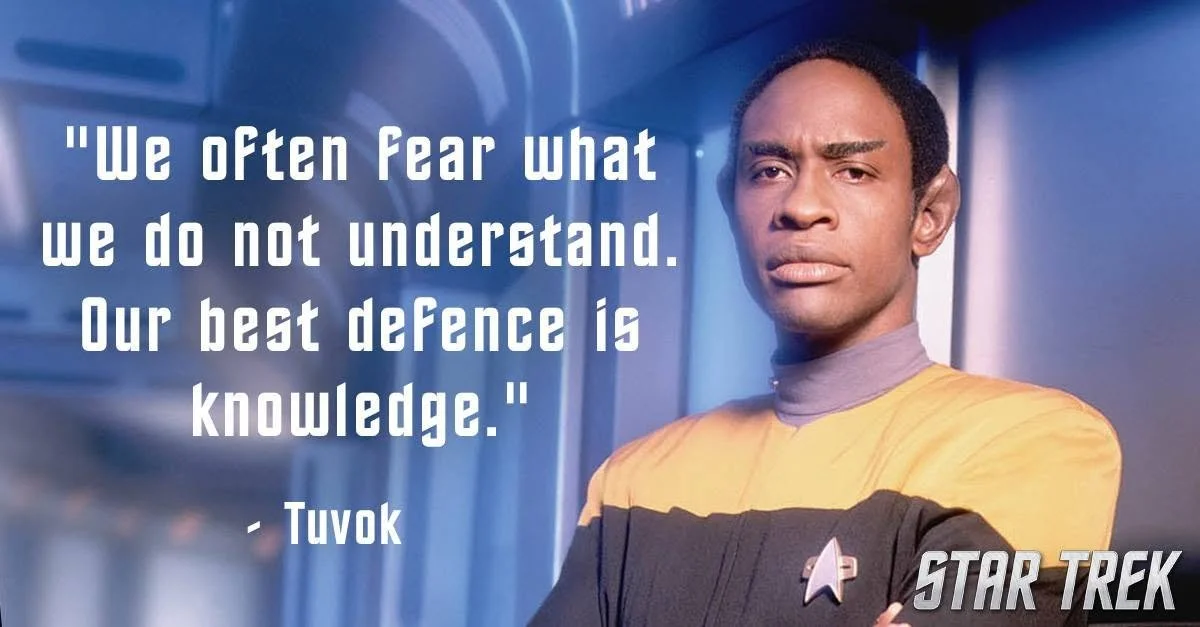
Star Trek: Voyager “Innocence” - 30:21 - - - Yes, I reference this a lot. 🖖
That philosophy was very much with me prior to my diagnosis, but it took on a completely different dimension after that.
When I first started on the brain cancer support groups I noticed how often people referred to themselves as warriors. They were fighting cancer, fighting tumors, fighting to the end.
I got the feeling behind it, the metaphor just didn't quite land for me. What exactly were we meant to be fighting?
My tumor wasn't an enemy out there actively making decisions. It was a biological process of mutation and change in the way the cells of my brain were behaving.
I couldn't just tell those cells to go fuck themselves and expect them to change their minds.
What I could do was get to grips with the biology, learn all about the treatments that were available and work with the doctors who had spent their lives studying the disease.
I never felt that my survival was going to hang on how aggressively I imagined myself fighting cancer. What I wanted was to understand what was going on and to be able to participate in the management of my own treatment in an intelligent way.
That doesn't mean the warrior metaphor is wrong for everyone. People get their strength in all sorts of different ways. For me knowledge was of more use than the feeling that you were up against an invisible enemy. It gave me a sense of agency.
The Surgery That Never Happened
In my previous article, Only Things Temporarily Hidden, I described my participation in a UCSF research study involving an experimental FET PET scan. My regular MRIs had started to show an abnormality in the area where the original tumor had been removed. It looked like it was growing and we were very concerned about recurrence.
My neuro-oncologist Dr. John de Groot thought radiation necrosis was the likely culprit. Radiation can cause delayed tissue changes which can on occasion mimic recurrence of cancer on an MRI.
That explanation was perfectly sensible to me in the light of what I knew about my original tumor and the sheer extent of treatment I'd had. It didn't mean that recurrence was ruled out though and I fully understood why they wanted to look further.
The FET PET scan gave us more information, though the results were still equivocal. That's a wonderfully frustrating medical word. After all the technology involved it had pretty much just been a very sophisticated version of 'maybe'.
As the abnormality kept on changing my doctors eventually recommended LITT (laser interstitial thermal therapy). That would involve using a laser, precisely guided, to heat up and destroy the abnormal tissue within the brain.
I knew the risks, particularly after the neurological changes I'd experienced following my initial surgery. The prospect of losing some element of creativity, memory or perception was far more unsettling than the surgery itself.
Nevertheless I was rather upbeat.
I wanted to get to grips with the technology, how the surgeon would be steering to the target and what the procedure might actually reveal.
Then I started to question my own emotional reaction.
I've spent a long time getting to know complex PTSD and the way prolonged trauma can affect the experience of fear and anxiety. I was wondering whether my apparent calmness in any way was a product of that.
Was I emotionally detached? Was my brain somehow failing to grasp the seriousness of the situation?
It was an odd problem.
I was becoming anxious about not being anxious.
By the morning of October 1 I'd pretty much come to terms with the fact that it would go ahead. I checked into UCSF Mission Bay, changed into hospital clothes and got into the usual pre-op routine. There were needles, there were questions, there was equipment and there were conversations with the younger medical staff who were a bit taken aback by my apparent level of interest in the procedure.
One woman said that I knew more about my condition than most patients. I remember her expression afterward. She looked rather sad actually, though I couldn't quite work out why. Probably she was just thinking about what it must be like to have that knowledge, or perhaps I was just projecting too much.
Then our surgical team went through the detailed BrainNav MRI from the day before. The abnormality had reduced in size considerably.
I was there when a number of the doctors were going over the findings. Dr Hervey-Jumper eventually came in and said the imaging no longer met the criteria to go ahead with LITT.
They were canceling the surgery. Just like that. I'd spent days in the run up to someone actually putting a laser in my brain and now I'm just getting dressed and ready to go out of the hospital.
The whole thing was utterly surreal. I was relieved of course, but equally intrigued by what had occurred.
The doctors had received new information, reconsidered the situation, and changed their decision. There was no dramatic announcement or mysterious intervention. The evidence had changed, and because of that, nobody needed to put a laser into my brain.
I thought that was a pretty good result.
Antimatter, Gamma Rays, and a Little Star Trek
Back at home I was still thinking about the FET PET scan I did in July and the fact that the technology involved was something which rather unnervingly looked like it ought to be on the USS Enterprise.
Antimatter. Yes, actual antimatter.
The tracer used in the scan was fluorine-18 (a radioactive isotope of fluorine). Fluorine-18 emits positrons. A positron is the anti-particle of the electron and when it meets an electron it annihilates, producing gamma ray photons.
The PET scanner picks up pairs of these photons and reconstructs images which show where the tracer has accumulated in the body.
For someone who grew up watching Star Trek, the notion that matter-antimatter annihilation could help doctors investigate my brain was absolutely fascinating. We weren't building a warp engine, but the physics was real.
And then, after I was discharged, I discovered something else.
In September 2026, before my surgery was canceled, the FDA had approved the FET PET imaging agent Pixclara to assist clinicians in differentiating between recurrent or progressive glioma and treatment-related changes.
Shortly thereafter UCSF published an article outlining how their research supported the approval. That was significant as UCSF is where I've had all my brain cancer care since my initial diagnosis, including the research study that I was part of.
My individual scan didn't give a clear answer and I don't know whether it in any way contributed to the evidence that led to approval. I had, however, had a first hand experience of the technology as it was being investigated in the research protocol.
Now it's becoming available for wider clinical use.
It's not always a revolutionary new treatment that's the advance. Sometimes it's just a better way of looking at what you've got, which in turn enables the clinician to make more informed decisions.
Given what had just happened with my canceled surgery, I found that particularly encouraging.
UCSF also published FDA Approves PET Imaging Agent for Brain Cancer
Faith, Knowledge, and a Klingon Messiah!
There’s another Star Trek episode I’ve been thinking about lately. In The Next Generation episode Rightful Heir, the legendary Klingon spiritual figure Kahless appears to have returned after centuries. His arrival inspires enormous religious enthusiasm, but they eventually discover he’s a clone created from preserved genetic material.
The revelation shakes Worf’s faith.
During a conversation with Data, the Enterprise’s android officer, Worf struggles with the relationship between evidence and belief.
Data once wondered if he was nothing more than a machine running on his programming or if he had the potential to become something more. He couldn't prove all of his hopes regarding his own potential but he did choose to believe that he could transcend his original programming.
He calls that decision a leap of faith.
I've always liked that scene because Data doesn't dismiss the evidence. He simply acknowledges that some questions can't be answered with the information at hand.
And I think that distinction is important when people talk about faith in the context of serious illness.
I've met a lot of people who are believers in religion, who pray and who have the belief that there is some higher power that is guiding their lives. I've also met people who have had very unexpected medical improvements and have referred to those as miracles.
I can see why those ideas can be comforting and I don't think belief and scientific knowledge have to be in any way in conflict.
But belief alone won't tell you whether the abnormality on your MRI is recurrent astrocytoma or radiation necrosis. It won't tell you what the genomic changes are or whether the surgery is still indicated. Those questions require evidence.
Faith may help us endure uncertainty, but knowledge gives us the means to investigate it. For me that distinction has been the crucial one. I don't see myself as some cancer warrior who has somehow beaten an enemy through sheer determination. My initial treatment was very extensive and my recovery was very difficult. I still don't know what the next set of MRIs will show.
People whose cancers have progressed in the face of treatment haven't necessarily failed to fight hard enough and people whose disease has improved haven't necessarily shown greater courage.
Biology doesn't distribute outcomes in accordance with how deserving we are.
What I find so encouraging is that the researchers are continually coming up with new ways of looking at these diseases and that patients are increasingly able to get involved in the decisions about their own care.
I've thought about that morning at UCSF quite a few times since I was discharged. I remember the needles, the conversations with the junior people and then the moment our surgeon came in and explained that the latest imaging had changed everything.
But what continues to interest me isn't simply that they canceled the operation. It's how differently I approach uncertainty now compared with a few years ago.
Following my initial diagnosis I knew absolutely nothing about brain tumors. All of a sudden I was confronted with a whole load of medical jargon, faced with very difficult treatment decisions and the sheer horror of the fact that there had been a mass growing in my head that I had no idea about.
Over the following few years I learned enough to start to understand what had actually happened. That knowledge didn't remove the uncertainty at all and it certainly didn't enable me to predict the future but it changed my relationship with the unknown.
By the time I got to UCSF on October 1 I was sufficiently familiar with my condition and the proposed procedure that I could go into it with genuine curiosity.
I wasn't ignoring the risks at all. I wasn't even experiencing the sheer terror that I'd thought I would.
Perhaps the most bizarre thing was that I actually for a moment took my own calmness as being some sort of evidence that there was something wrong with me.
Rather than wondering why I wasn't actually frightened, I should have been asking why I thought fear was the appropriate reaction to begin with.
I still don't know exactly why the abnormality in my brain shrank in size. Radiation related changes are still a possibility but I'll need further imaging and more discussion with my doctors to get to the bottom of it.
More questions and potentially more surprises. I’m comfortable with that.
On the October 1 I walked into UCSF expecting someone to put a laser in my head. A few hours later I walked out the door without having had the operation. The doctors had looked at the latest evidence and changed their decision.
Somewhere along the way, I realized that the most fascinating thing about the experience wasn't simply that my surgery had been canceled. It was that I'd spent nearly five years learning enough about my condition to approach another brain operation with curiosity rather than overwhelming fear.
I still don't have the full picture of what's going on in my head and neither do my doctors.
But we’re learning, the universe still has loads of things that are temporarily hidden.
Fortunately, I’ve never needed to understand everything to keep asking questions.